


Another way of looking at it is that the F-wave are good for blasting with a 5 batten sail. It is when you get onto 6 batten sails that like to be locked down that the outboard straps come into their own.
Beiträge von Sailrepair
-
-
I have the F-Wave in 95,105 and 115. I certainly don't need all three sizes but I have them. They are all very similar but for my 95kg each one has its uses.
When comparing the 95 to the 105 or the 105 vs the 115 there is not a big difference of when they get planing.
For me at 95 kg-
95 - for sails 3.8 to 5.4.
105 - for sails 5.0 - 5.9. When there are holes in the wind and maybe I will want to uphaul.
115 - for sails 5.0 - 6.5. When uphauling is likely. In truth I don't use this board much as the 105 can do most of the same things just a little bit better.
I should say that I only sail on the sea, in fresh water the bigger boards would be better. All three boards gybe well but it is only if you want to turn tightly for wave riding or 360's etc then the 95 and 105 are better. If you will be just blasting and just doing a basic gybe then the 115 is fine.
-
I have the GT3 Foil in 4.0, 4.6, 5.2, 5.8, 6.4 and 7.4.
I like the 4.0 and 4.6 for strong winds and find them especially useful for offshore winds. The head area on the small GT3s is very small so you don't suffer in strong gusts.
-
I went to Boa vista At the end of January into February in 2023, I sailed 5 out of 7 days two of which I was over powered on 5.3 and I am 95kg. Ie it was 25+ kts. The other 3 days I was on a 5.9 or 6.5. There were small (head high) waves which I could get a few turns on before they broke on the beach. At the end of the week the wind went and the waves came. The whole west coast had mast high waves with no point breaks and the waves closing out up to half a km offshore. But the wind was 10 kts, strong enough if there had been a channel to get out but not to try to sail out through the waves.
Since then I have been the Sal a few times where the wind has been 20kts at the most and more like an average of 15 kts.
-
I think the way Patrik has developed the foil is different to many other brands. A lot of brands are designed by mathematical modelling and just a little bit of conformation testing. It seems like Patrik did a lot of on the water testing like the conventional way boards are designed.
-
Externer Inhalt youtu.beInhalte von externen Seiten werden ohne Ihre Zustimmung nicht automatisch geladen und angezeigt.Durch die Aktivierung der externen Inhalte erklären Sie sich damit einverstanden, dass personenbezogene Daten an Drittplattformen übermittelt werden. Mehr Informationen dazu haben wir in unserer Datenschutzerklärung zur Verfügung gestellt.
-
I have just done a blog on the aeon foil that I hope some people find interesting
Real world windfoil choices .
Below are my thoughts on windfoil choices for the real world conditions most of us sail in. This is written about the Patrik Aeon foil but a lot of it will be applicable to other foils.
Why am I doing this? There is already a lot of information online about ideal foil set up but I find most of what is written is aimed at racing. I don't race but I do like going as fast as possible, especially in light winds. I also want maximum control in gusty strong winds. I do most of my foiling in a sea loch on the west coast of Scotland. The water is surrounded on three sides by mountains so it can be gusty to say the least. We also get squally winds coming off the Atlantic so 10 to 25 kt wind range is not unusual. While these conditions can be demanding they do mean you can test things very quickly as the chances of being both under and over powered in a ten minute period are quite high.
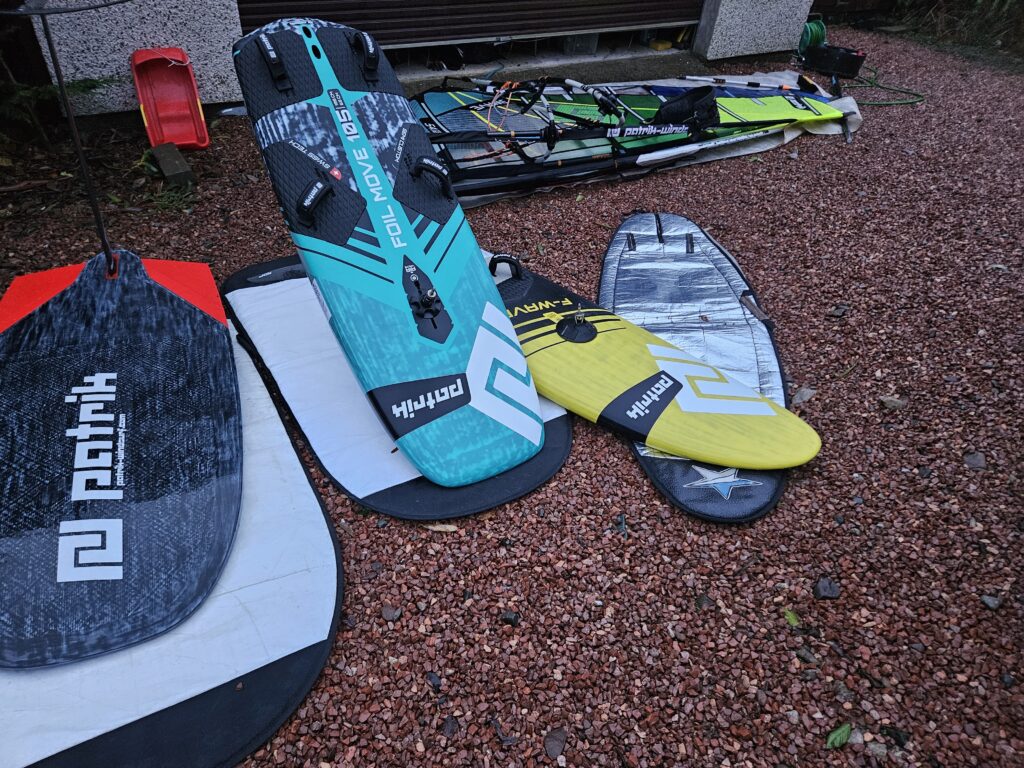
Light winds 6- 10 kts
95s mast + V1 TI fuselage – I use this mast because it is the thinnest and therefore the most efficient and light winds are all about efficiency. Whatever rear wing (stab) I use it is set in the rearmost position for maximum stability. I always use the +1' shim as I find that works fine on both sizes of stab and on both my fuselages.
On a general note – I always use the 190 stab with the 750 and 900 front wings and the 160 stab with 650 and smaller front wings.
The board will always be a Patrik Foil Comp 85, sail a Patrik S2 8.4 or 7.8 meters.
Choice of front wing for light winds? A lot has been written about what the PWA sailors are using but I am not racing. If I look at the water and I can see some gusts of maybe 7 kts but between the gusts the wind looks more like 5 kts then maybe I will go with the 900 wing with the aim to get flying in one gust and then manage to fly to the next gust and gybe in that to try to keep flying. The larger wings help to maintain sustained flight. If the gusts are 8+ kts then maybe I will go with the 650 front wing which will give me more speed and I can still get through the light patches of wind but I will need to find another windier patch to fly round in a gybe.
To try to quantify things, I would say I need to get the board moving at about 5kts to take off with the 900 wing and about the same with the 750 wing. The difference being the larger wing can take off in a shorter distance which is useful if the gust is only 15 meters wide and you have to take off in that space. The 650 wing needs the board to be wound up to about 8kts board speed. That is possible in say 8 kts of wind but you need to consider the size of the windy patches and how smooth the water is. These are the sort of things I find no one is talking about and are quite important. Maybe you have read that some great racer can get his board flying in 6 kts with an 8.4 sail so you take yourself off to your local lake to do the same. But the wind is onshore and the small chop is bouncing back off a wall creating a nasty short chop, you will then find it very hard to get the board up to take off speed. You can get a similar situation on the open sea where you can only get flying in one direction because the other direction you are trying to take off directly into the waves and you just can' t build the speed up. Whereas in the other direction you can get the board on the downslope of a wave and use it for a bit of a push.
Whether you are using a 9.0 or 7.5 meter sail for your light wind foiling the thing is having enough wind to pump against. If you give your rig a quick pump you will quickly know if there is any power there for you to use to build up to take off speed.
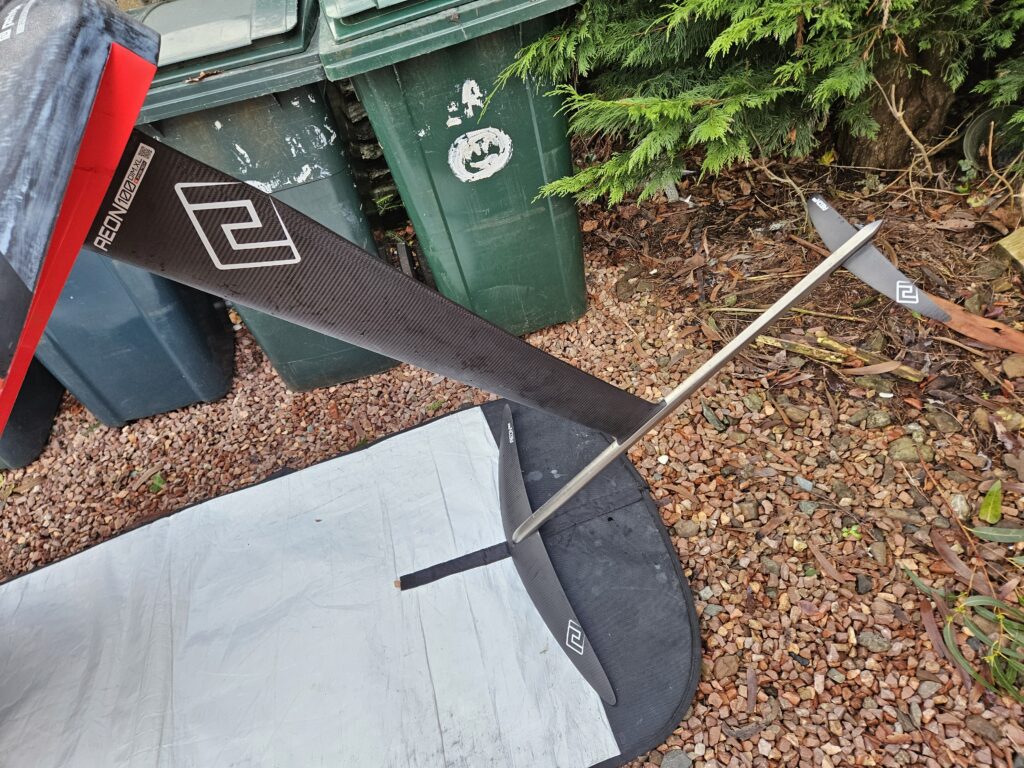
Medium winds 10 -18 kt
95s mast – for maximum efficiency
Or
100 XL mast – if the sea state is getting higher and I think “longer the better”.
Fuselage V1 so that I can get maximum lift from the front wing. But sometimes V2. The V2 fuselage puts the front wing about 2cm further back. The end result is similar to if you moved all your footstraps 2 holes forward. In effect it tames things down a bit. I use the V2 fuse when the wind is offshore when I need as much range out of the foil as possible.
Board will be a Patrik Foil Comp 85 or 78 or even a Patrik foil move 105. Sail – Patrik S2 7.8, 7.2, 6.6 or maybe a big wave sail if I am traveling somewhere with limited kit.
This is when things start to get a bit more diverse. In light winds efficiency is the goal which mirrors what any racer would be trying to achieve. But in 15 kts of wind there can be a divergence of interests.
If the water is flat and I feel like it I may choose to keep to the efficiency principles of a large sail and a small front wing on the V1 fuselage so that I can go as fast as I can (I am not a fast foiler, but what I mean is “fast for me”)
So I would be on the 95s mast, v1 fuse, 650 or 450 front wing and 160 stab. Sail wise would be 7.2 or 7.8.
BUT there are days with flat water when I don't want to be going fast! Why? Because we can get days in the summer when there are big rafts of seaweed floating about or days in the winter after storms when there are lots of things in the water. Times like that require more or a cruisey attitude and I might use the 750 front wing and a slightly smaller sail.
On more open water 15 kts of wind can make the water anything but flat. And maybe trying to race across 1m high chop requires a bravery I left behind some years ago. In such conditions I would go for the longer 100 mast and perhaps the V2 fuselage and then choose between the 650 and 750 front wing.
Strong winds 18 – 30 kts
Both masts are still applicable but I would err towards the longer 100 mast.
Fuselage – V2
Board – Patrik Foil comp 78 or Patrik Foil move
Sails – patrik GTS foil 5.8 or Patrik ride foil 5.4 or wave sail down to very small.
Front wings 750, 650 or 450
I can hear you think “750 is a light wind wing” but above a certain wind strength I often find myself going back towards larger wings. Yes, there is the race philosophy of more wind = smaller wings and there is some logic to that but I will explain why it often doesn't work for me. Again I need to emphasize I'm not racing, just looking to enjoy myself on the water. While some people are lucky and sail in places that can have steady strong winds, unfortunately I am not so lucky and a windy day may see the wind varying between 15 and 40 kts.
Small wings and sails – small wings need a fast water flow over them to enable them to fly. That in turns requires a constant drive from the rig. In effect it doesn't matter if the drive comes from an 8.5 meter sail in 10kts of wind or a 3.5 meter sail in 30 kts the pressure is similar. That is why the PWA sailors can use very small front wings in only moderate winds and it is often easier to provide steady drive into the foil with a big rig in a moderate wind. Compare that to when you are out flying happily in 20 kts of wind and a rain squall suddenly puts the wind up to 30+ kts. The usual solution is to ease off and sheet out a bit but small front wings don't really like that and you can find your session becomes very stop/start.
Linked to what I have said above is the type of sail you use. Foil race sails with all their cams and forced draft/shape in the sail provide a very constant power source. They are great and a definite bonus towards level flight in gusty conditions and are able to fly through holes in the wind better than anything else. But what happens when you become overpowered? You can't help but sheet out a bit and the sail will then provide “half power”, you can't completely switch the power off. You have to hide the sail when entering gybes but you can certainly still have a good session. If the wind picks up further then it becomes very uncomfortable. A rotational foil sail may lack the grunt for the earliest of take off but can be a pleasant sail even in lighter winds. In strong winds when you have to sheet right out suddenly you have no power at all. If you are quick you can keep flying by using short pulses of power but generally you will find it hard to maintain flight on a small front wing. It comes down to personal choice and what sails you are using but don't always follow the mantra of the windier it is the smaller the front wing you must use.
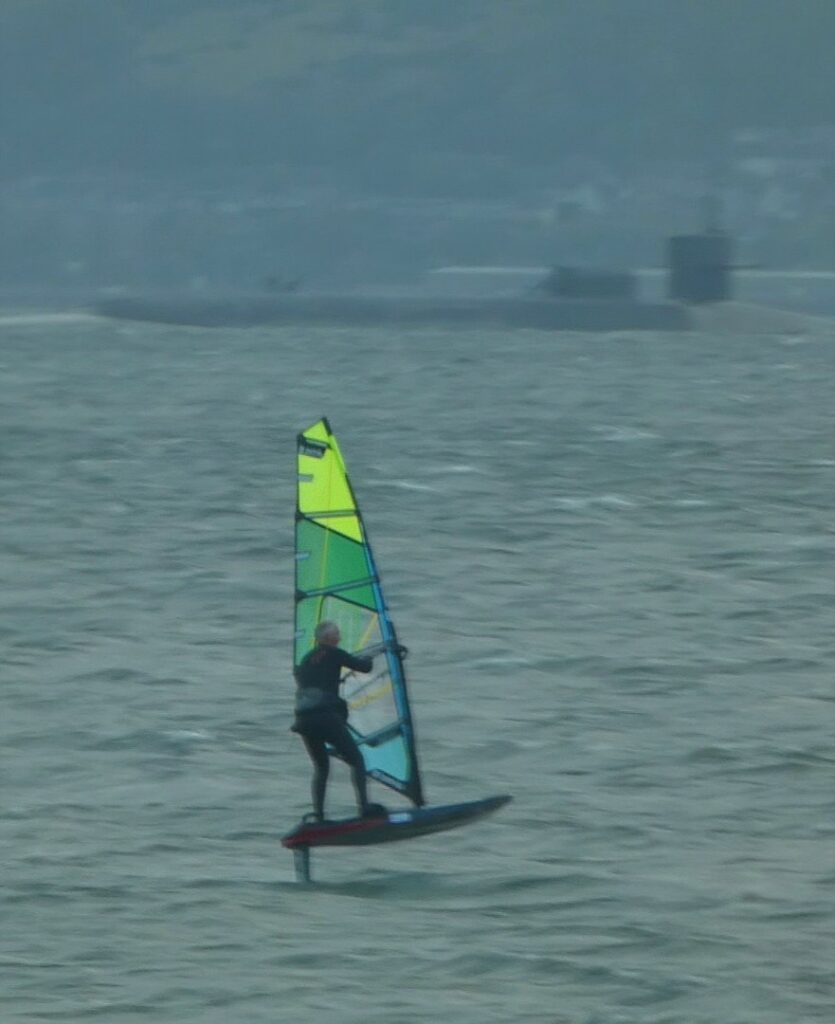
On my foil move 105 I only use front wings from 650 upwards and will use a smaller sail. I also move the rear wing forward to give quicker height control which is useful when the waves are getting bigger.
Summary
There are many ways you can look at the relationship between front wing size, sail size and wind strength. Here are some of my thoughts on the matter.
In light winds I can get flying in 10m on the 750 or 900 wing, with the 650 I might be pumping for over 50m to wind up to take off speed so bare that in mind if you are sailing on a small lake where the gusts are the size of a tennis court. Small wings and early flight lend themselves more towards places where the patches of stronger wind are the size of a football pitch.
In moderate winds – if you have enough wind to easily waterstart you should have enough wind to keep a small foil wing going. I don't think it matters if your power source is 4 or 8m as long as it is powerful enough to waterstart.
In strong winds remember you can be a hero and chase 30+ kts but you can also go on a bigger wing and smaller sail and gybe away until your heart's content.
I am 95kg, 59 years old and have a mental age of 18. .
-
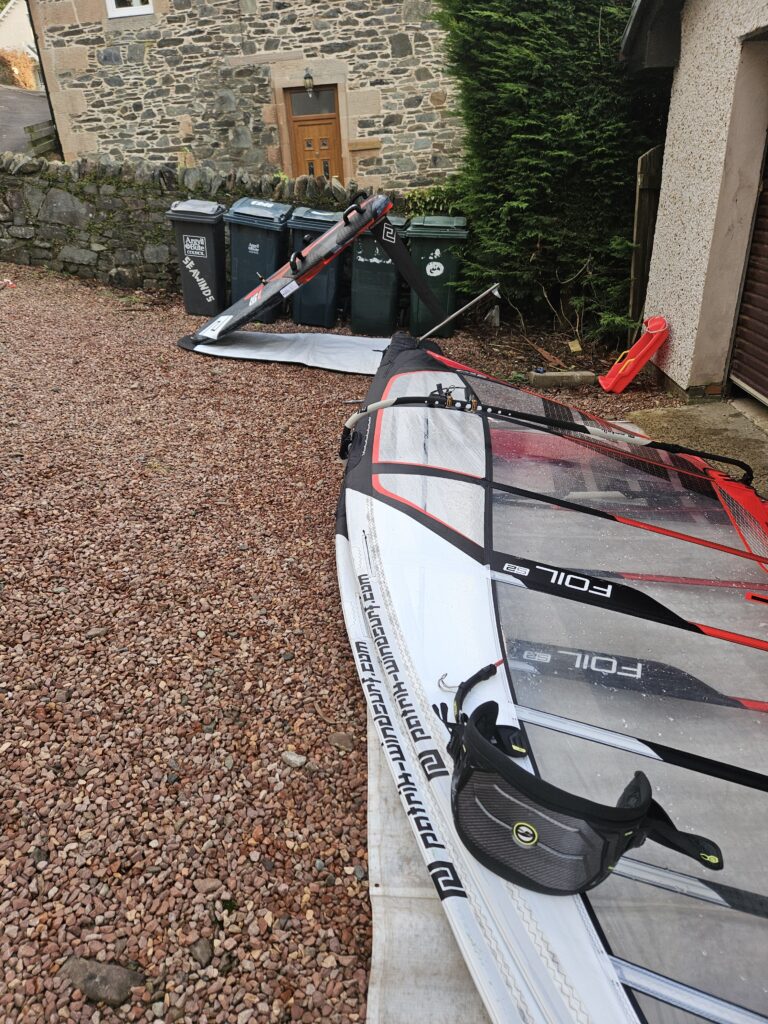
Yes, I use it on a RDM and I have just gone out to check and there is one spacer on each cam.
-
I have the 5.8. I have only used it a few times but I am getting to like it very much. Compared to my other sails which are the Patrik S2 the GT-3 foil has more tuning range. You can leave it with a tight leach or you can carry on down hauling and end up with a looser leach which is very useful for gusty days. It feels light in the hands and rotates very well.
I think after the summer I will change my whole quiver over to the GT3 foil.
-

Patrik F-Wave, together with 3S+, is probably the best one board only solution in the test if you want to sail from 7 to 4.2. Unfortunately it's not in the test either.
The F-wave is in the magazine that has just been published. We could not get the board to them on time for the main test so they have done a "catch up" test.
-
You can come and windfoil with me.
Deep/very deep water.
No kitesurfing
No jet skis
I live right next to the submarine base in Scotland. The water is obviously deep and it is tightly controlled by the navy so no kitesurfing and no fast boats. They put up with me but I have to phone the harbour master to check there are no submarines passing.
I used to get chased by the police boats which was quite fun but since covid we have come to an understanding and they leave me alone as long as I phone in advance. During covid I got to my third and final warning from the police as they didn't think windsurfing was "permitted exercise".
Der Inhalt kann nicht angezeigt werden, da Sie keine Berechtigung haben, diesen Inhalt zu sehen. Der Inhalt kann nicht angezeigt werden, da Sie keine Berechtigung haben, diesen Inhalt zu sehen. Der Inhalt kann nicht angezeigt werden, da Sie keine Berechtigung haben, diesen Inhalt zu sehen. -
 Alles anzeigen
Surface Aeon Foil original:
Foilmast is completely dry within 20-3 seconds, so it has a hydrophobic surface.
Der Inhalt kann nicht angezeigt werden, da Sie keine Berechtigung haben, diesen Inhalt zu sehen. After sanding with a sanding sponge, the mast is still wet even after 10 minutes... so a significantly better hydrophilic surface.
Der Inhalt kann nicht angezeigt werden, da Sie keine Berechtigung haben, diesen Inhalt zu sehen. Schmams are from Amazon
My masts stay wet.
-
I think it is important to realise that with the Aeon foil you can get probably 90% of the performance of the full on Pwa foil for 60% of the price by choosing the alu fuse etc.
Regarding the mast fust connection I press mine together etc etc before tightening the screws and I can still get a turn on the screws after sailing. With my dims mast it is a slight effort to disassemble but with the XL it if a big effort to get the fuse off and I'm a big guy.
-
That sounds good. I see that most people are putting the stab in its rear position. But I would like to experiment in moving it forward and use a bigger front wing to get a more reactive and wave friendly feel.
-

Thank you very much!!
what fuse-to-board ankle did you use?
it is about 2.5' on the Patrik Foil Comp and about 3.5' on the foil move.
With the foil move (which is the same board as the old foil ride) being only 195 long it has a tendency to bury its nose on touching down. But in a way it is quite nice if the last thing you see as you get launched over the front is the nose of the board 30cm under water. That way you know the board will not get any damage.
-
Here is my first impressions of the foil.
first a bit of background - i am 95kg, 58 and definitely not a PWA racer. I would call myself a "steady sailor" I can go many sessions without ever falling in but I don't foil at PWA speeds.
5 to 10 kts - XL mast, V1 fuse, 900 M, 195 stab +0.75 shim - It felt no dissimilar to my old AFS foil - would get me flying at about 6 or 7 kts and could then fly through 5kt winds with a Patrik 8.4 S2. Everything felt good, not too much lift in the gusts.
The next day started the same but I had the 165 stab and +1' shim and the foil felt a bit faster and better. The wind increased to about 15 kts and I was starting to sheet out the 8.4 sail so I changed the front whing to the 650 H. Things felt good, quick and easy to gybe. I think changed the sail down to 7.2 and kept the foil the same. The foil certainly feels low drag and the 650 wing flies as easily as my old 700 AFS.
Same foil again but this time with a 6.6 sail. All good, I could keep control even though over powered. Eventually I changed down to -
Patrik Foil Move with the S mast, V2 fuse, 480 H front wing and the 165 stab and +1' shim and a 5.4 sail. Now lots of things happened, the wind rapidly increased to about 20 to 25 kts. With the foil I was still having to use a lot of effort to get flying. In fact half the time I was blasting about as if I had a fin under my board, In a strange way the novelty of it was quite fun. The board is only 195cm and it seemed as happy on the water as above it. Anyway it took a lot of board speed to take off but once flying the foil felt a bit nervous but then I am not that used to such a short wing span and I guess that is inevitable. I think in general that foil likes to keep above 15 kts and as long as you are above that speed it was not difficult to gybe etc.
I would have used the V1 fuse but in my hurry to rig up and get back on the water I couldn't get the V1 off the other mast. I later had to take the foil off the board and stand on the fuse to get it off. I look forward to trying the 480 wing with the V1 fuse.
I think I will use the V1 fuse most of the time with as small a wing as possible so that I can keep flying so I have a comfortable but quick ride. BUT in the real non PWA world there are days when I don't want speed, those days where the waves are much taller than my mast, those days when you gybe down wave faces etc. For such days I think I will try the V2 fuse but with a bigger wing and see if that will give a more controlled ride in hard conditions.
Lots to play with.
-
I cut the tuttle head on my foil yesterday. The plan was to cut it at the top of the "cut line" and then sand it if required.
It is actually quite hard to cut even with a good hacksaw and new blade.
With the cut at the top of the line the foil did not go fully into my foil comp boards. So I kept sanding and also checking the rake of the foil. Once I had it level with the bottom of the cut line it all fitted OK with about 3' of angle.
My other mast I have not cut and it fitted well into my Patrik foilmove board which had the deeper foil box. it had 4' angle. I am waiting on a new foil comp and I will use both masts with that and just use a thick shim at the back if I use the cut mast with it.
I just need a bit of wind to try it now, can't wait.
-
I got my foils air shipped and now I am waiting for them to come from Germany to Scotland.
I am getting the S mast and the XL. I have foil comp 78 and 85 and a foil move. I was told all the 2023 boards had the deeper tuttle box and indeed the foil move does have a deeper box. And although the foil -comp arrived as a 2023 board it has the shallower box. So I have ordered a new Foil comp 85 so I will cut only the XL mast and use the S mast with the foil move and the new foil comp when I get it. I can of course use the XL mast with all the boards + my AIO.
Since the normal deep tuttle heads have a gap of about 5mm on the older boards I don't think they will need cutting as much as people think.
-
Thanks as usual for the information Totti
Choosing just one foil board for the whole season will be tricky. I would think most will go for 85cm wide boards.
-
I have asked Patrik about backward compatibility but not had a reply. The new foils are slow to arrive and limited in options so I think they will have no choice but to keep the AIO system going for a bit longer. There is currently good stock of all the AIO components.